Does Hopping Make You a Faster Runner? What a 2023 Study Found
What if a simple 5-minute hopping routine could make you a faster runner?

Whenever I fly, it’s a great opportunity to read a book or some interesting articles because, on the plane, I always have dedicated time — I can’t go anywhere, so the best thing I can do is read.
Recently, I went on a business trip to Seattle, and since the total flight time from where I live to Seattle was around 14 hours, I took advantage of it and read some interesting things. For me, it’s also a great chance to download a whole list of YouTube videos and watch them during the flight.
This time, I chose a series of articles about running and a few videos on the same topic.
To my surprise, I came across an article about a 2023 study titled “Progressive Daily Hopping Exercise Improves Running Economy in Amateur Runners: A Randomized and Controlled Trial.” Researchers had runners perform in-place jumps following a specific protocol and analyzed the impact on their performance.
Study Design
This was a randomized controlled trial with 34 amateur runners (average age: 29 ± 7 years, 27 males). Participants were divided into two groups: the Hopping Exercise Group (HE), which performed 5 minutes of daily double-legged hopping for six weeks, and the Control Group (CON), which continued their regular training without additional exercises.
Progressive Load
The duration of the hopping session started at 50 seconds per session in Week 1 and gradually increased to 150 seconds by Week 6. At the same time, rest periods between sets were progressively shortened to enhance adaptation.
Measurements (Before and After the Study)
- Running Economy (RE): Oxygen uptake per distance at 10 km/h, 12 km/h, and 14 km/h.
- VO₂peak (Maximal Oxygen Uptake): A measure of aerobic fitness.
- Respiratory Exchange Ratio (RER): Indicates fuel utilization (carbohydrates vs. fats).
Key Findings
1. Running Economy Improved at Higher Speeds (12 & 14 km/h)
- At 12 km/h, the running economy significantly improved (p < 0.05).
- At 14 km/h, the improvement was even greater (p < 0.05).
- No significant change was observed at 10 km/h.
2. No Change in VO₂peak
- The hopping exercise did not impact aerobic capacity (VO₂peak remained unchanged).
3. Increased Respiratory Exchange Ratio (RER)
- Higher RER at 12 km/h and 14 km/h: Suggests increased carbohydrate utilization at faster speeds.
- No change in RER at 10 km/h.
4. Mostly well tolerated
- Most runners handled the daily hopping without problems, but two reported pain (shin and ball of the foot). Build up slowly, and stop if something hurts.
Key Takeaways for Performance
- Running economy improved by ~2% at race-relevant speeds (12–14 km/h).
- No change at slower speeds (10 km/h): Benefit applies to moderate-to-fast running.
- Higher RER at 12 and 14 km/h: the body burned relatively more carbohydrate at faster speeds. The authors couldn’t explain why, so I wouldn’t read too much into it.
- VO₂max remained unchanged, meaning the gains come from efficiency, not aerobic capacity.
Conclusions
- Daily hopping exercises improve running economy at moderate-to-high speeds in amateur runners.
- The authors suspect stiffer Achilles tendons are behind it, but they didn’t measure it*.*
- Short, simple plyometric training (hopping) is effective and feasible, as an additional training component.
- No impact on VO₂peak, meaning it can be added without affecting endurance training.
- Potential applications: Could benefit endurance runners and team-sport athletes.
Practical Takeaways for Runners
- Adding 5 minutes of daily hopping can improve running efficiency at faster speeds.
- Useful for distance runners aiming for small but meaningful performance gains.
- The exercise is simple, requires no equipment, and can be done anywhere.
- For optimal benefits: Focus on minimal ground contact time, explosive movement, and gradual progression.
8-Week Daily Hopping Routine
Format
- Exercise: Double-legged hops
- Goal: Explosive jumps with minimal ground contact time
- Total Time: 5 minutes per session
- Rest Between Sets: Decreases progressively
Execution
- Stand with feet hip-width apart.
- Jump as high as possible, keeping knees relatively extended.
- Land softly and immediately rebound.
- Keep the core engaged to maintain proper posture.
Week-by-Week Progression
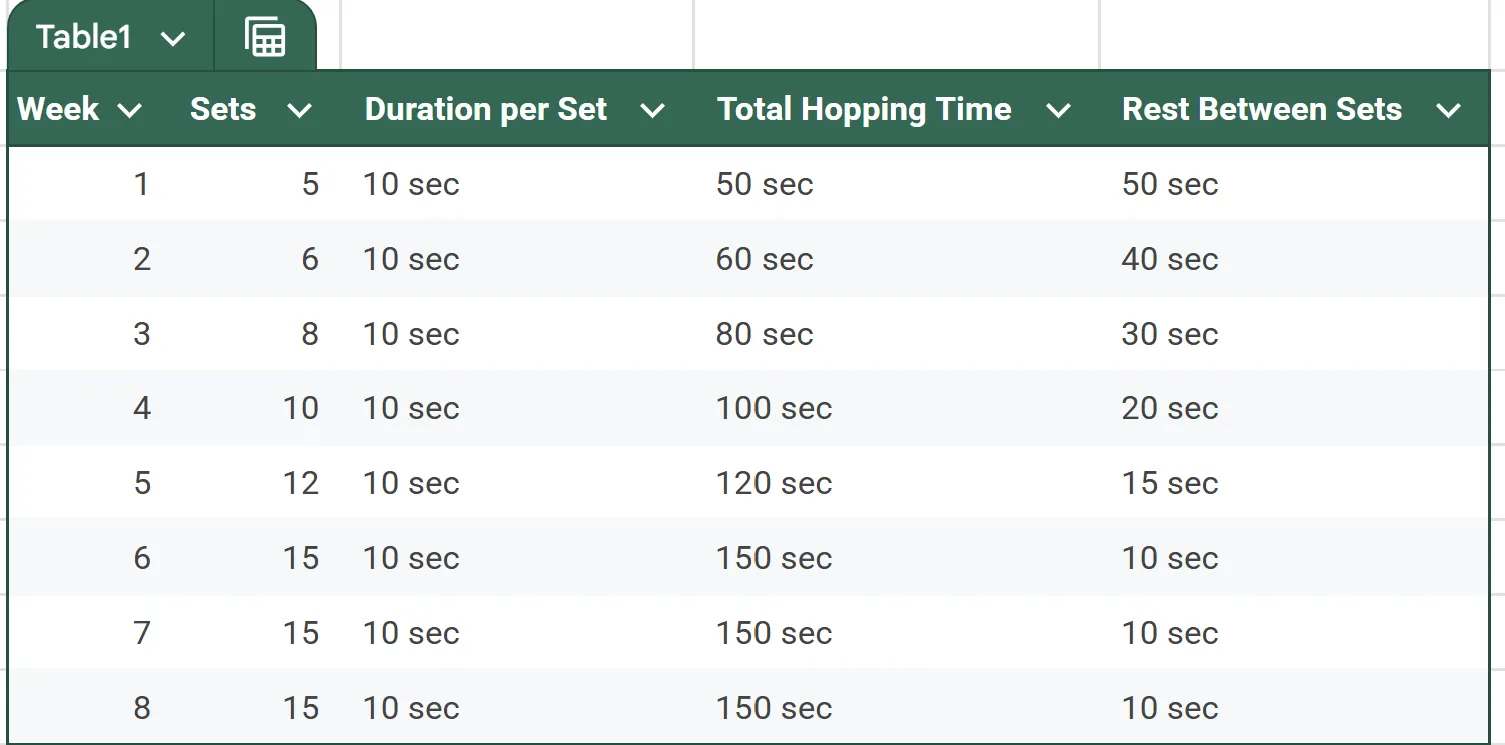
When to Perform the Routine
- Ideal Timing: After easy runs or before strength training.
- Avoid doing it before hard intervals or long runs to prevent fatigue.
- If fatigued, reduce the number of sets but maintain explosive quality.
Final Thoughts
- Running economy (RE) determines how efficiently you use oxygen at a given pace.
- Lower RE = more efficient running, using less oxygen to maintain the same speed.
- VO₂max is your aerobic ceiling, but RE determines how well you use that capacity.
- This small, simple hopping routine could be a game changer for endurance athletes.
Ready to test it on race day?
If you try the routine, you’ll want a fast course to test it on. I’ve been building a small personal project for exactly that: EuroSlam, a free calendar of half marathons and marathons across Europe, with the race-day weather, a speed score for every course and hotels near the start.
(EuroSlam is my own free side project. Some hotel links on the site earn me a small commission, at no extra cost to you.)
I’ll tell the full story of how it started, from a hand-drawn map and a Google Sheet, in my next post.
Happy running, and tell me in the comments if you try the hopping routine!
I'm a recreational runner with an office job, testing running science on my own legs. More about me.